
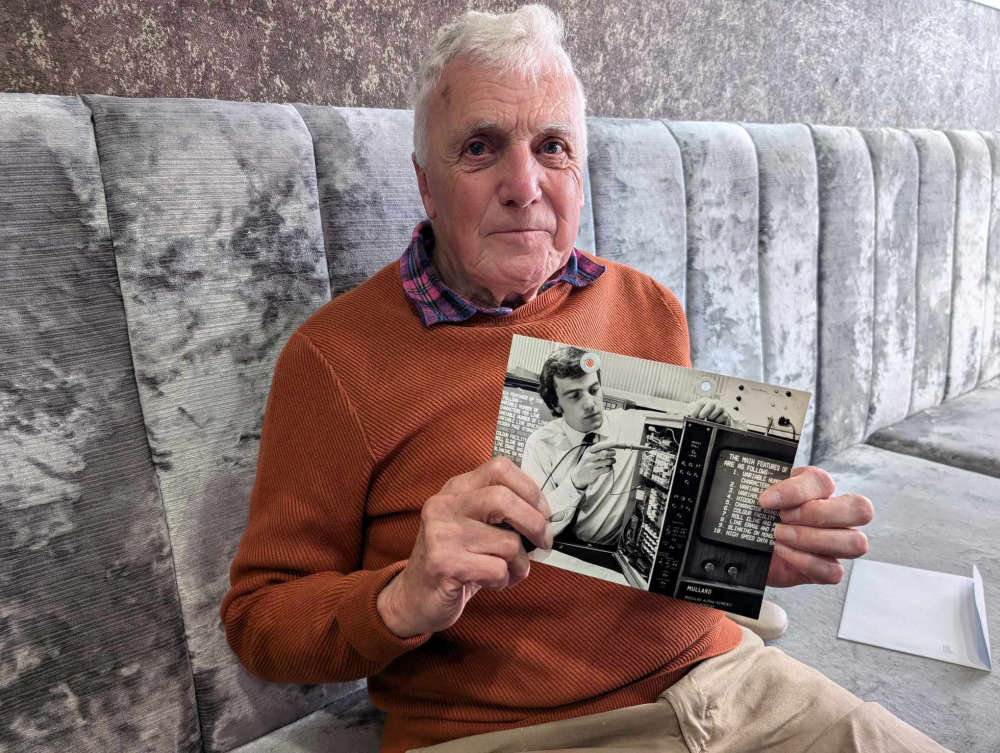
Ian Hanson helped devise some of the most groundbreaking technology of the past 50 years - not realising at the time how it would change the world.
Ian, from Morecambe, was part of the team in the 1970s who developed what went on to become known as Teletext, and was used by the BBC for their popular Ceefax service.
The television text information system, which celebrated its 50th birthday recently, would go on to attract 22 million users before dying with the rise of the world wide web.
It broke the biggest stories on the BBC and ITV ahead of the television news, in the days before the internet, and provided hundreds of pages of easy-to-access information on everything from current affairs, sport and weather, TV and radio listings, to travel and games and even Valentine's Day messages!
See below for a typical BBC Ceefax screen. Image from the BBC.

But when Ian and a team of electronics developers were hard at work in Surrey labs creating what they affectionately called 'Mandi', they had no idea how big the project would become.
LISTEN to Ian Hanson talking about how he helped to develop Teletext
"In 1973 I was tasked to work on what they called at the time a Visual Display Unit so we could assess how many characters per line we could reasonably display on a TV screen," he said.
"This was something brand new at the time."
Our photos show Ian working on the new system during the 1970s.


"At the peak there were about 16 of us working on it. My colleague John Adams was the chief designer of it. I was helping him with that design and coordinating with the other people working on it. It was an interesting time.
"I didn't evisage it becoming what it did become. I was just intrigued by the technology, really."
At the time Ian worked for Mullard's, part of the electronics giants Philips, in Mitcham, Surrey.
"The management within Mullard's, they decided that they wanted to demonstrate this to a company in Norway and to this we had three months to design, develop and make a prototype," he said.
"John Adams and myself, and our boss Gerald Crowther, we were each working getting on for 100 to 120 hours a week for about three months, to make sure we met the timescale for it. We weren't getting much sleep.
"We called it Mandi, which was the Mullard Alpha Numeric Display Instrument. That was a name that stuck to it within the company."
At the time, Ian recalls helping to give presentations and demonstrations all over Europe, to bigwigs from some of the biggest broadcasting companies in the world.
"We had a visit from the BBC and later IBA (ITV) and they thought wow, this is something we can really use," he said.
"We were envisaging only 40-50 pages. We were staggered really when it got up to hundreds of pages on it.
"We were using the very first Random Access Memories in this system, that were made by Intel. That in itself was interesting, because it was all brand new technology at the time. We were breaking new ground."
The BBC started their Ceefax system in 1974, ending it in 2012.
"This was the first time that people could select what information they wanted to view and display it on their televisions," said Ian.

The ITV network's version called Oracle began in the late '70s and was later on Channel 4, but ended in 1992.
Later in his career, Ian went on to work for mobile giants Sony Ericsson.
He worked on the very first Smartphone that had ever been made and went commercial, the Ericsson R380, in 2000.
Ian, 76, who is originally from the Manchester area, now lives in Morecambe after moving here in 2017.

 Police issue quicksand warning after riverbank danger for school pupils in Lancaster
 Lancaster animal shelter launches 'Big Build' fundraiser to help save charity
 LISTEN: Morecambe "definitely submitting a bid" to become first UK Town of Culture
 Heysham Port upgrade blamed for traffic chaos 'trapping residents in their homes'
 LISTEN: Tourism champs hail Eden Project and Tour de France as huge for Morecambe Bay area
 Donation helps college pan ability football team to play in national championships
 LISTEN: Meet the new manager of the Midland Hotel in Morecambe
 LISTEN: Main contractor to build Eden Project Morecambe to be announced this month
 £1.2m of funding for flood defence schemes in Lancaster district announced
 Morecambe Bay hospital trust unveils new painless blood test
 Thousands raised to help boost return of Lancaster Music Festival
 High street computer games shop in Lancaster closes down
 LISTEN: Carnforth actor wins Hollywood and Paris awards for horror film role
 "1600 potholes repaired last week" says councillor as roads debate rumbles on
 Burger King takeaway in Lancaster city centre closes down
 Morecambe lifeboat crew reunite dog lost on sands with owner
 New Morrisons Daily supermarket opens in Morecambe
 Council investigate after derelict food trailer found dumped in Lancaster layby
 Man charged after pedestrian died in Morecambe hit and run
 LISTEN: We go out on Pothole Patrol in Morecambe