Archaeology and cutting-edge science have come together to unlock secrets and rewrite the stories of Lancaster district’s ancient past.
Human remains dating back thousands of years have been brought out of the stores of Lancaster City Museums – up to 100 years after they were first discovered – with some being re-analysed in collaboration with a team of experts from Lancaster University.
The result of this, together with knowledge gained from previous scientific analyses which have already reshaped long-held beliefs about local history, is ‘Life After Death’, a new exhibition at Lancaster Maritime Museum which opened on Saturday.
Professor Adam Taylor, Dr Jemma Kerns, Dr Nai-Hao Yin and Twezher Gurdji from Lancaster Medical School helped to examine some of the museum’s archaeological samples for the exhibition using Raman spectroscopy - a powerful tool which uses laser light to reveal the chemical makeup of materials.
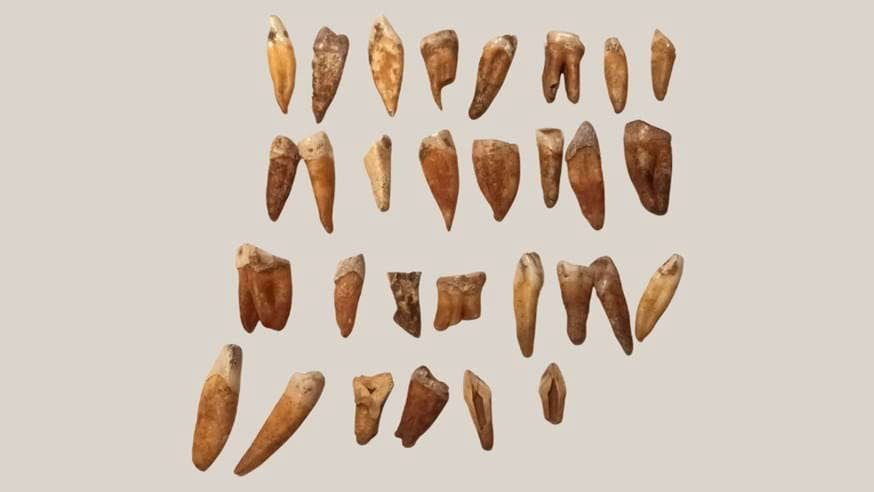
The technology was used on some of the museum’s archived teeth and confirms whether remains were cremated or buried, offering up fresh opportunities to confirm burial practices, aid site dating, and get a new perspective on ancient rituals and beliefs.
Professor Adam Taylor, of Lancaster University Medical School, said: “This project shows how important archaeological and historical museum samples are in modern science. Novel techniques such as these reveal new information about the aspects of individual’s lives and health through their mineralised tissues.”
The brand-new Life After Death exhibition enables visitors to come face-to-face with bones and artefacts from local digs.
The displays look at how scientific technologies have revealed secrets buried for thousands of years and shaped our understanding of local history - each with its own remarkable tale.
One of the exhibits includes teeth from the Manor Farm Bronze Age burial site, which after undergoing Raman analysis, helped to confirm how the site was used and that there were cremations at the place, confirming that Raman technique can reveal important information about archaeological materials.
Dr Jemma Kerns, Senior Lecturer, Lancaster Medical School, said “We were really pleased to be able to apply our knowledge in Raman spectroscopy to learn more about archaeological samples.
‘’Raman spectroscopy particularly lends itself to studying precious and rare artefacts and remains because it can analyse them without causing any damage.”
The exhibition also features remains from Vicarage Field in Lancaster, once thought to be medieval, but revealed as part of a mighty Roman fort from the 1st to the 4th centuries, thanks to decades of meticulous scientific archaeology.
Bones of arctic hares and lemmings from Dog Holes in Warton, a cave that served as a burial site from the Stone Age right through to Romano-British times, have revealed just how cold the climate once was around Lancaster.
There are also bones and artefacts from Dog Hole in Haverbrack - the largest Romano-British burial site in the North West - where at least 33 individuals were uncovered from unborn babies to people aged more than 50-years-old. The use of isotope analysis has helped to better understand the diet and gender of the remains found.
Councillor Sam Riches, Lancaster City Council member with responsibility for museums, said: “This project began as a collaboration between the museum and university researchers exploring new applications for Raman technology. This exciting project focused on local historic remains and opens doors for future discoveries worldwide.
“A clear chemical difference between cremated and buried teeth was found, paving the way for future research, and proving that museum collections are vital resources for research.
“This kind of exhibition is important for our local community as it reminds us that our understandings of the past are not static. It shows how assumptions about our history can be wrong, and that by returning to these historical questions with enhanced perspectives and cutting-edge technologies we can reveals new aspects of the past and reveal fresh insights about the people who lived here long before us.”
The exhibition runs until April 25, 2026.

 Appeal launched to help save Morecambe sports and social club
 Reopening date announced after Morecambe Jobcentre closes for repairs
 Lancaster charity urges residents to know how they’re affected by Renters' Rights Act
 Lancaster district residents urged to check their details as annual electoral canvass begins
 E-bikes and e-scooters seized during police crackdown on Lancaster cycle track
 Four vehicles involved in road collision in Carnforth
 LISTEN: Popular vlog tells story of couple's second-hand bookshop dream in Morecambe
 Emergency team in Silverdale receives donation of life-saving kits
 MP offers support to staff after Morecambe FC reported to The Pensions Regulator
 Track night at Lancaster sports club to launch police safety scheme for women and girls
 PHOTOS: Live music day to raise funds for homeless people in Lancaster hailed as huge success
 Former bank turned live music venue in Morecambe to reopen under new management
 New parking system set to launch at Royal Lancaster Infirmary
 Museum in Lancaster up for award launched by TV historian David Olusoga
 MP fights for refunds after Heysham medical centre patients get parking fines in error
 Two teenagers arrested after car stolen during Hest Bank burglary
 Parents demand further action after health watchdog probe into asbestos complaints at Lancaster school
 LISTEN: Lancaster medical students praised for helping man who collapsed
 Man arrested on Morecambe beach after report of assault
 Police probe burglaries in villages near Carnforth