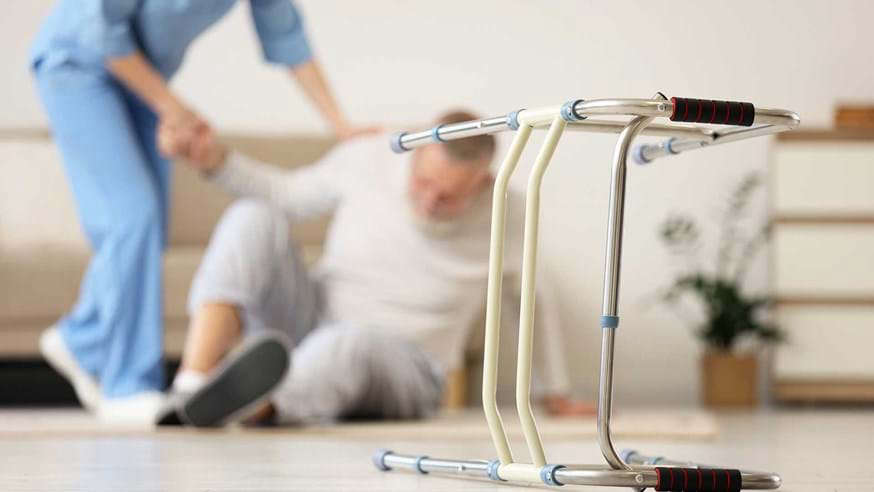
The use of AI smart lights in care homes reduces falls by around a third, say Lancaster University researchers.
They evaluated the use of this technology in care homes in South Lancashire and Cumbria.
Falls are among the leading causes of emergency admissions from care homes in Lancashire and South Cumbria, and many care homes consistently experience fall rates above 22 per cent per 100 beds over a six-month period.
To test whether advanced technology could help, NHS Lancashire and South Cumbria Integrated Care Board (ICB) funded the roll-out of around 800 AI-powered Nobi smart lights across 79 residential homes and nursing homes over a two-year-period.
The homes that were picked for the scheme were prioritised to receive the Nobi lights because they face the greatest risk and have the most to gain from technology that can prevent unwitnessed falls, accelerate staff response and reduce avoidable harm.
Some staff from Lancaster University Centre for Ageing Research were commissioned by the ICB to conduct an independent evaluation which found that:
· The number of falls overall was reduced by 32%
· There was a reduction in total ambulance callouts by 23 per cent
· Ambulance callouts resulting in hospital conveyance were reduced by 24 per cent
· Over half of the care home managers felt that the use of the technology contributed to an overall improvement in residents’ well-being
· 80% of the care home staff felt confident in using the technology
Professor Carol Holland, Director of the Centre for Ageing Research at Lancaster University, said: “This the largest evaluation of such technology used in a care setting, with the independence from the company and the robust analyses used adding credibility to the very positive findings.
“The combination of different types of data examined ensured the voices of the care staff were included in the evaluation, giving us important insights on how the lights worked in a real-world context, what were the features, and how the staff used them, that resulted in the reductions of falls.”
Across Lancashire and South Cumbria, providers are supporting people with greater frailty, more advanced dementia and higher levels of clinical complexity, while also facing significant staffing pressures.
There was a significant improvement in the care home staff response times to fall occurrences from an average of 11 minutes before the Nobi device was used to an average of 2.99 minutes after this device was implemented. This showed that the device helped in reducing long lies among the residents.
Dr Andy Knox, medical director at NHS Lancashire and South Cumbria ICB said: “Falls are one of the biggest reasons for hospital admissions in our region so it was crucial that we explored new forms of technology and how it could be harnessed to predict and prevent falls.
“We are extremely pleased with how well the Nobi smart lights have worked, by not only ensuring residents who have fallen are responded to quickly, but by also communicating with care staff in telling them how the fall occurred which in turn has helped prevent future falls.
“Prevention is key to reducing falls and the information that Nobi has been able to supply to staff has resulted in changes being made to the environment which is why this technology has been so significant in keeping people safe.”
Councillor Graham Dalton, cabinet member for Adult Social Care at Lancashire County Council, said: "These results show how innovative technology like the Nobi smart lamps can make a big difference in keeping residents safe and reducing future falls which should offer reassurance to care home residents and their loved ones.
"It's really positive to see care homes embracing technology for the benefit of their residents."
Roeland Pelgrims, chief executive officer at Nobi said: “Seeing the real-world impact of Nobi in Lancashire and South Cumbria has been incredibly rewarding.
“The results from the evaluation demonstrate how AI-enabled care technology can play a vital role in reducing falls, improving response times, and ultimately enhancing safety and quality of life for residents in care settings.”
The Nobi smart lamps were installed in residents’ bedrooms and monitored their behaviour and movement 24/7. If a resident falls, the lamp detects this immediately and speaks to the resident, asking if they are okay. In the event of no response or a call for help, the intelligent lamp is pre-programmed to send a message to the care team plus an image to show where and how the fall has occurred.
The use of Nobi lights in care homes is estimated to generate an average annual saving between £16,110 and £33,606 per home, with annual savings across all homes between £918,306 and £1,915,549.

 Tour de France comes to Lancaster district: Full route breakdown
 Serial burglar jailed for seven years after spree of Lancaster break-ins
 Storm boards on Morecambe Prom ahead of "exceptionally high tides" and strong winds
 Councillor apologises and admits "we got things wrong" over Blue Badge parking survey
 Heysham 2 apprentice scoops national award
 Former MP David Morris officially selected as Conservative candidate for Morecambe and Lunesdale
 Extra staff and extended opening hours among plans as Lancaster hospital prepares for winter
 What's On: Our Halloween and bonfire/fireworks events guide
 Lancaster champion calls for more respect for businesses after spate of youth crime
 Lancaster MP "disappointed" in Government decision on Jackdaw gas field
 Morecambe announced as key part of Lancashire stage of Tour de France
 Lancaster, Morecambe and Carnforth Remembrance services announced
 LISTEN: Lancaster prisoners carve penguins for Christmas trail with a difference
 EXCLUSIVE: Massive Wagons to headline Lancaster Christmas Lights Switch On 2026
 Morecambe mum celebrates podium success at Ms Great Britain Classic
 LISTEN: Inside transformation of historic former Morecambe pub and hotel
 Heysham car sales boss "massively disappointed" after losing appeal over ex-pub land
 LISTEN: Photographer meets 'Alternative Kids' 46 years on for emotional reunion
 Council deal with more than 4,000 fly-tipping incidents in Lancaster district since start of year
 Police issue warning about cold callers in Carnforth