

A physicist from Lancaster University has helped to develop technology on board a spacecraft heading to the planet Jupiter.
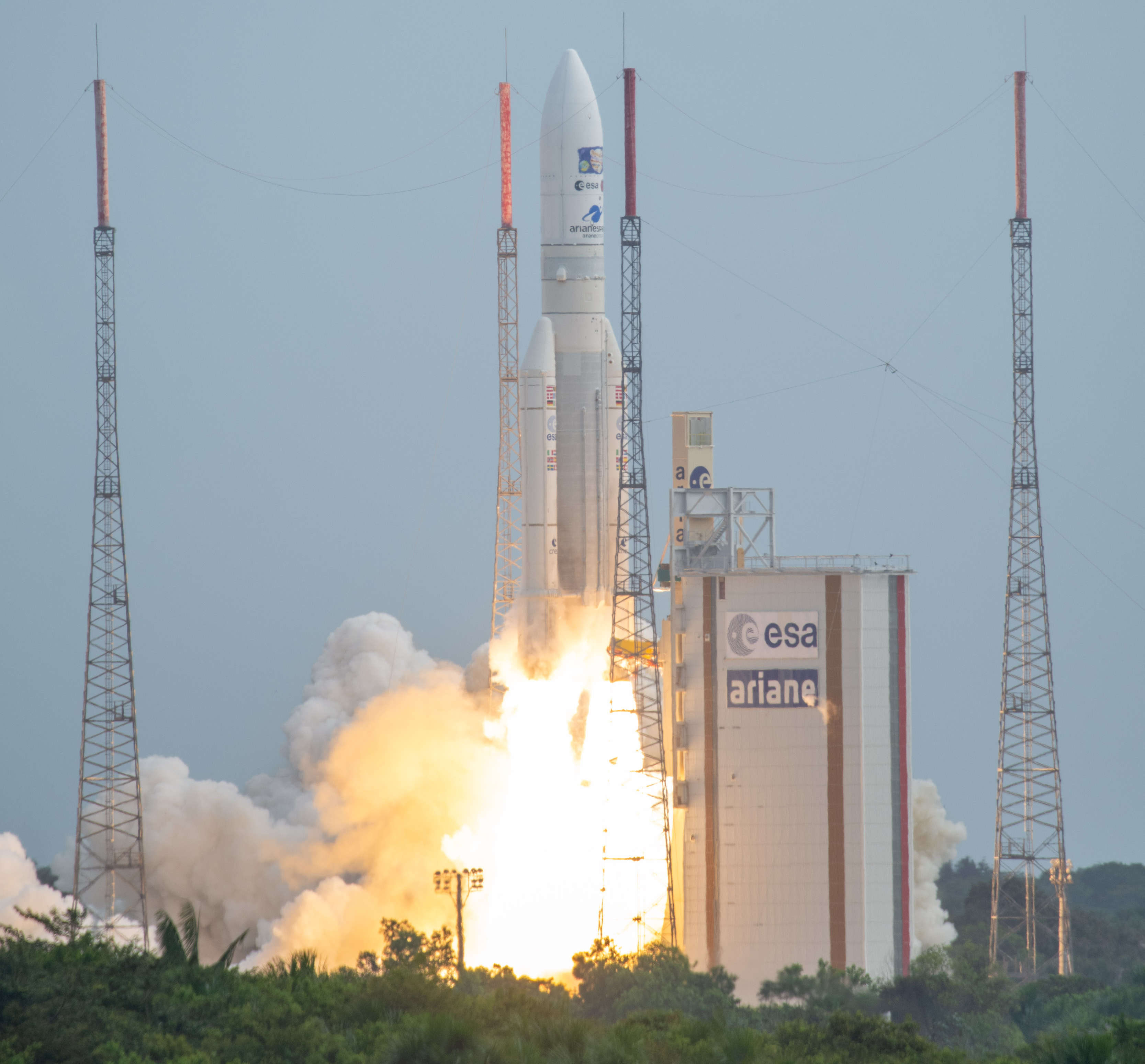
Dr Chris Arridge has helped to develop instrumentation on the European Space Agency (ESA)’s Ariane 5 spacecraft which launched from its spaceport in French Guiana.
The JUICE (Jupiter Icy Moon Explorer) mission will investigate the planet's main icy satellites Europa, Ganymede and Callisto as potential habitable bodies and in particular seek to understand their interiors and how they couple to the surface.
It blasted off on April 14 on an eight-year journey to reach the icy moons of the planet, after being delayed for a day due to bad weather.
Dr Arridge is Reader in Planetary Physics at Lancaster University where he is a co-investigator on the JUICE magnetometer instrument 'J-MAG' led by Imperial College London.
He said: “The spacecraft will take about eight years to reach Jupiter, but we will be doing science along the way.
"Once JUICE reaches Jupiter it will orbit the planet, doing quick flybys of the icy satellites, before going into orbit around Ganymede itself. It will end its mission with a controlled crash on the surface.”
JUICE will also explore Jupiter as an “archetype” for gas giant planetary systems – what can Jupiter and its planetary system tell us about gas giants in general, either in our solar system or further afield.
J-MAG will measure magnetic fields around Jupiter and around Europa, Ganymede and Callisto.
These measurements are important because, amongst other information, they yield information about salty liquid oceans underneath the icy crusts of the satellites.
When these changing magnetic fields reach these icy worlds, they are modified by what they encounter inside – like a salt water ocean which is electrically conducting.
“By measuring how these changing magnetic fields are affected by the moons we can work out what is inside them," said Dr Arridge.
"How thick the oceans are, how deep they are under the icy surface and how salty they are, for example.”
Ganymede - the largest moon in the solar system - is the main focus of the mission.
“Ganymede is the only moon in the solar system known to have its own magnetic field like that of the Earth," he said.
"You could use a compass on Ganymede, just like you can on Earth.
"JUICE and J-MAG will also study this magnetic field and the consequences of Ganymede having its own magnetic field. For example, there are northern lights on Ganymede and JUICE and J-MAG will look at how these are produced.”
J-MAG is located on a 10.6m arm that keeps the instrument far away from any sources of magnetic fields on the spacecraft that would otherwise contaminate the data.

 Appeal launched to help save Morecambe sports and social club
 Reopening date announced after Morecambe Jobcentre closes for repairs
 Lancaster charity urges residents to know how they’re affected by Renters' Rights Act
 Lancaster district residents urged to check their details as annual electoral canvass begins
 E-bikes and e-scooters seized during police crackdown on Lancaster cycle track
 Four vehicles involved in road collision in Carnforth
 LISTEN: Popular vlog tells story of couple's second-hand bookshop dream in Morecambe
 Emergency team in Silverdale receives donation of life-saving kits
 MP offers support to staff after Morecambe FC reported to The Pensions Regulator
 Track night at Lancaster sports club to launch police safety scheme for women and girls
 PHOTOS: Live music day to raise funds for homeless people in Lancaster hailed as huge success
 Former bank turned live music venue in Morecambe to reopen under new management
 New parking system set to launch at Royal Lancaster Infirmary
 Museum in Lancaster up for award launched by TV historian David Olusoga
 MP fights for refunds after Heysham medical centre patients get parking fines in error
 Two teenagers arrested after car stolen during Hest Bank burglary
 Parents demand further action after health watchdog probe into asbestos complaints at Lancaster school
 LISTEN: Lancaster medical students praised for helping man who collapsed
 Man arrested on Morecambe beach after report of assault
 Police probe burglaries in villages near Carnforth